Who Are You Exactly Making This For?
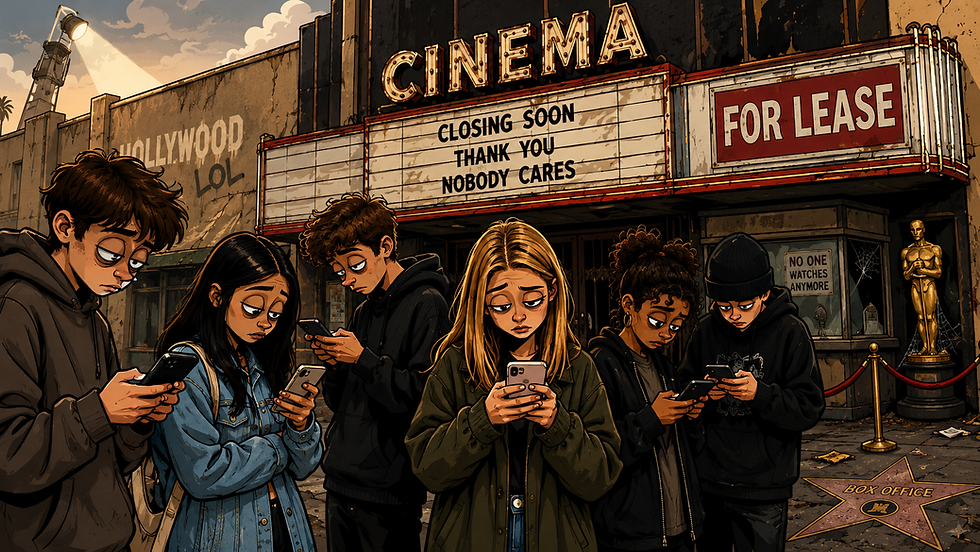
Gen Z is not behaving like the audience most independent film decks still describe.
59% of Gen Z subscribe to a streamer for a single title and cancel after watching.
62% will not pay full price for a video game.
71% have stopped buying physical music.
70% no longer buy hard copies of TV or film.
The one bright spot is narrow: Gen Z is 13% more likely than older demographics to attend opening weekend in theaters.
As a reminder, the 79th Cannes Film Festival opened, which means several thousand independent filmmakers, sales agents, and producers will spend the next 2 weeks transacting against the 13%.
So now, take your project, open the audience slide on your deck, and go to the section that describes a paying viewer.
The viewer it describes is the same person the data says will not pay.
The standard response is that the project does not need them as a direct paying viewer because a streamer will acquire the finished film and absorb the audience question on its end. That answer is weaker than it was 5 years ago. Streamers are reading the same behavior. They know a large portion of the audience signs up for one title, watches it, and leaves.
Acquisitions now have to function as the title someone subscribes to watch, not the title they casually discover while scrolling. A 90-minute independent feature with no built-in audience is asking for sustained attention from a viewer trained to abandon paid platforms the second the specific title is consumed. Acquisition offers priced against that behavior got smaller, then rarer, then largely stopped for the bottom 2-thirds of the slate.
The acquisition argument has a fallback.
When the SVOD streamer answer evaporates, the next answer is “Tubi!”, the Fox-owned, ad-supported, free-to-the-viewer service the industry treats as the floor option when nothing else takes the film. Free to the viewer does not mean valuable to the rights holder. A non-exclusive Tubi deal often carries no upfront license fee. Earnings come from ad revenue, and the reported per-view revenue can land around $0.005 to $0.015 per view before platform share and aggregator fees.
One published example shows a film generating 2M Tubi views at a $10 CPM and 60% revenue share returning roughly $12,000 to the rights holder. Most independent features released on Tubi do not approach 2M views, and a large share do not approach 200,000. The “we’ll just sell to a streamer” answer, followed to its actual end, often lands on Tubi, returning a 4-figure number against a 6 or 7-figure production cost.
That gap IS the result of building for an audience that was never proven to exist.
The library answer is a number copied forward from an earlier era. The pitch deck waterfall lists secondary catalog earnings at year 4, 5, 6, and 7. 70% of Gen Z does not buy physical copies of film or TV. 71% does not buy physical music. The calculation is intact, but the consumer it describes no longer exists in the volume the calculation requires.
Theatrical is the one place the data tilts toward independent work, and even there the tilt is conditional. Gen Z is 13% more likely than older audiences to attend opening weekend. That does not mean they are wandering into random independent films. They show up when the film is part of a broader social event.
A night out.
A group decision.
A cultural appointment.
Studio tentpoles qualify through marketing spend in the hundreds of millions, and a small number of independent releases qualify after months of audience work. Most independent features are not appointments on opening weekend and were never positioned to become one.
The more important finding is buried underneath the cancellation numbers. The audience still rewards continuity. They return for sagas, multi-season stories, recognizable characters, long-running worlds, and IP that gives them a reason to come back. A standalone independent feature is the inverse of that behavior. It enters the market with no prior installment, no continuing saga, no embedded fanbase, and exits without producing one. Even when the demographic shows up to pay, they are paying for continuity and recognition, neither of which a debut feature automatically offers.
The broader point is simple in that each generation is consuming entertainment through a different set of habits. The independent distribution path still assumes an audience running on the previous one. That sequence was a working description of how an independent film reached a paying audience in 2015 with Sundance discovery, sales agent attachment, mid-tier acquisition by a specialty distributor, a theatrical window, a streaming output deal, and library earnings on the back end. It is a working description of almost nothing in 2026. The buyer at every layer of that sequence has either rationed acquisitions to titles that already arrive with their own audience or exited the segment entirely.
The second finding that gets ignored is that paid entertainment has not been abandoned. Gen Z and millennials still hold active subscriptions. They still spend on entertainment. They still show up for titles that matter to them. Generic spending is what has stopped, and the spending that continues goes to things the consumer specifically identifies with, while everything arriving without that identification is ignored by default.
That finding is the answer to the title question.
It is also the answer most independent filmmakers do not want to do the work for. A filmmaker who spent 2 years building a direct audience around a recognizable identity, a defined genre, a regional perspective, or a sustained body of prior work walks into distribution with the one thing the data says actually moves the demographic to pay. The filmmaker who delivers the finished film to the festival circuit assuming the circuit will produce that audience is asking a system that no longer performs that function to perform it anyway.
The same failure shows up in the raise.
Who are you raising for?
Not emotionally.
Not because the project means something to YOU.
Not because this is YOUR passion project.
Yawn
Who is the actual private money audience being asked to believe this project has value? Most decks answer that question with autobiography. The filmmaker cares. The writer suffered. The director has a vision. The team believes in the story. None of that explains who the film serves, why that audience will show up, how the release reaches them, or why this project deserves funding before 400 other films asking for the same thing.
Private money is not funding your need to make the film. It is funding a specific path to audience attention, buyer interest, rights value, or future company value. If the raise cannot name who benefits from the film existing beyond the filmmaker, the raise has the same problem as the audience slide.
It is describing desire instead of demand.
The reaction to this argument is reliably to blame the receiver. Festivals reject too many small films, streamers got cheap, theaters will not book independent work, distributors got predatory. The statements are partially true and entirely beside the question. The question is what the filmmaker did to address the audience condition the finished film requires. The data describes the demand side, and the supply side is whatever the filmmaker actually did during the 2 or 3 years between greenlight and delivery to meet it directly.
There is no only one task that precedes every other task on an independent feature in 2026.
Identify the buyer or build the audience directly.
The buyer is a named streamer with a named acquisitions executive, a named territory partner, a named niche distributor with a defined channel into the audience the film serves, or an audience the filmmaker has built and can deliver to a release. The audience measured here is not the audience for the unsold independent film. They are the audience that pays attention to work that arrived with an audience already attached, and stops paying for everything else.
Who, exactly, is the film for?
Name them in one sentence.
If that sentence does not exist, the film does not have an audience.


Comments