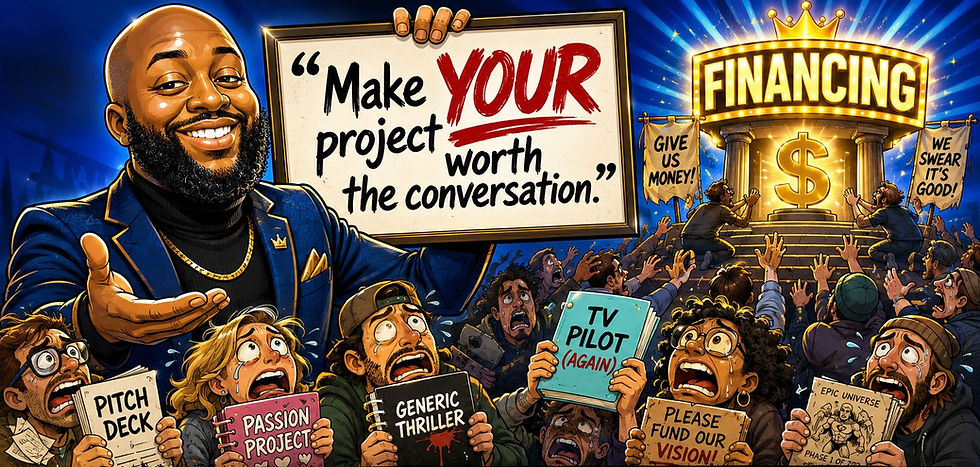
Make YOUR project worth the conversation.
I would say 99 out of 100 calls I have in a week sound some version of this:
“I’m currently focused on closing financing directly.”
“I’ve been fortunate to have mentors already advising on the structure side, so I’m going to stay concentrated on investor conversations.”
That is polite.
It is fair.
It may even be honest, BUT it also raises the only question that matters: if the people around the project already know how to prepare it for investment, why has the project not received investment?
That question is not cruel. It IS the job. Startups and independent filmmakers have become very comfortable mistaking activity for proof. A mentor call, a warm intro, a producer attachment, maybe a pitch deck, the classic festival submission, a generic sales-agent conversation, the usual verbal “interest”, and my favorite, a vague “we’re talking to investors.”
The problem is that none of those things are financing. They are surrounding events. They can help, but they do not prove the project is investable. They prove people have been willing to take a call, read a deck, give feedback, or stay close enough to see whether something real forms. That is not the same as money committed.
The current marketplace is not forgiving that confusion. Domestic box office in 2025 was roughly $8.66B, only about 1% above 2024 and still below 2023’s $8.91B. The number of domestic releases was high, but average gross per release remained limited compared with earlier recovery years. That matters because an independent film raise cannot pretend theatrical demand is automatically waiting on the other side of production. The marketplace is crowded, attention is fragmented, and even finished films compete for limited buyer appetite, limited screens, limited ad dollars, and limited audience urgency.
The top of the market is also not behaving like a charity for original independent films. In 2025, the highest-grossing domestic releases included A Minecraft Movie, Lilo & Stitch, Superman, Jurassic World: Rebirth, Zootopia 2, Wicked: For Good, and Avatar: Fire and Ash. Those are not unknown filmmakers asking strangers to trust an undeveloped finance story. They are franchise, remake, sequel, adaptation, brand, or built-in audience plays. Even Sinners, one of the more important original theatrical breakouts of 2025, came from Ryan Coogler and Warner Bros., not from a first-time filmmaker with ambition full of adjectives and a budget built to imitate a studio movie from another era.
That does not mean independent film is dead. That phrase is lazy and usually said by people who mistake pessimism for analysis. It means the burden of proof is higher. If the market is rewarding recognizable properties, then the unknown project has to compensate with a sharper case.
Who is the buyer?
Who is the audience?
Why this format?
Why this price?
Why this release path?
Why this budget?
Why this team?
Why now?
Why should someone believe the project can ROI instead of becoming another title in the great landfill of “almost there” film packages?
The market itself is oversupplied with projects claiming they are ready. With Cannes wrapping up as I write these words, the Marché du Film describes itself as the world’s leading film market, with roughly 1,500 screenings, 250 industry events, 600 exhibitors, and 4,000 projects. That is not a cozy “room” where everyone gets discovered. That is a factory of competing asks. Showing up with the usual passion, script, a budget top sheet, and consistent bullshit is not a strategy. It is a ticket into a large space full of people saying the same thing, often louder, often with better attachments, and often with more defensible commercial logic.
This is where the language starts to break. Filmmakers often point to the orbit around the project as if it answers the issue inside the project. Advisors, producers, intros, feedback, festival interest, soft commitments, sales conversations, and “people circling” can all sound productive. Sometimes they are. But none of them make the project financially legible. A serious package has to explain the ask, the cost, the audience, the route to market, the likely buyer, the repayment path, and the reason the project deserves priority now. If those answers are weak, the surrounding activity does not protect the project. It makes the weakness easier to see.
As of May 21, 2026, the production environment is not giving independent filmmakers more room for soft asks. Los Angeles finished 2025 with 19,694 permitted on-location shoot days, down 16.1% from 23,480 in 2024. It was the lowest annual total since 2020, the pandemic year everyone keeps treating as if it belongs in a sealed museum case. Q1 2026 showed selective improvement, with 5,121 shoot days, up 10.7% from Q4 2025, but still down 3.3% from Q1 2025. Features reached 687 shoot days, up 52.3% year over year, and FilmLA noted that most Q1 feature activity came from independent films. That sounds useful until the broader picture walks in and ruins the party, as reality tends to do.
Television remained ugly, with 1,196 shoot days in Q1 2026, down 28.4% from Q1 2025, and The Hollywood Reporter noted that total Q1 shoot days were still nearly 30% below the 5-year average. So the real read is that a few categories are crawling upward inside a damaged system. That makes loose independent raises harder to defend, not easier. If the market has fewer active lanes, fewer reliable buyers, less production overflow, and more projects fighting for less attention, then walking in with “we just need financing” is lazy. In this environment, a weak ask looks unserious.
The decline is not merely a Los Angeles labor story. It is a signal about the broader reset. Streamers no longer operate like bottomless rescue vehicles for every completed film. Buyers are more selective. Distributors are less willing to overpay for projects that do not already show audience pull. The old fantasy was simple in that you make the film, get into a festival, trigger buyer heat, secure distribution, then let the market solve the business problem. That shit still works occasionally, which is precisely why people keep worshipping it. Lotteries also produce winners. That does not make a lottery ticket a finance plan.
Pre-sales remain part of the market, but in 2026 they are not carrying weaker packages the way filmmakers want to believe. Cannes 2026 opened with record market attendance, roughly 16,000 registered participants and about 4,000 films and projects competing for attention, while coverage pointed to a market tilted toward smaller films, cautious buyers, and fewer automatic studio lanes. Buyers are looking at cast value, genre demand, territory performance, sales estimates, release path, comparable titles, budget discipline, and repayment probability. If those pieces are thin, the pre-sale conversation does not validate the project. It exposes the gap.
That is why the line “I’m focused on closing financing directly” often sounds less like discipline and more like avoidance. Direct conversations are useful only after the project can survive direct questions.
How much has been raised?
How much is committed?
What money is soft, what money is real, and what money disappears the moment someone asks for documents?
What is the actual shortfall?
What is the repayment path?
What are the assumptions?
Who has passed?
Why did they pass?
What changed since then?
If those questions make any one person tense, the issue is NOT the investor.
The issue IS the project.
A strange culture has formed around independent film raising where the filmmaker believes the investor’s job is to “support the arts,” while the filmmaker’s job is to remain creatively pure and financially vague. That is not how investment works in any field in any industry. There is nothing wrong with patronage, grants, crowdfunding, or community support. Those are real lanes BUT if the ask is investment, then the project has to be built for an investment conversation. It cannot rely on the emotional premise that a stranger should fund the dream because the dream feels meaningful to the person dreaming it.
Hard fact: a finished film is not automatically more valuable than an unfinished one. A completed film without distribution, audience proof, buyer demand, marketing money, or a credible repayment path can be less financeable than a well-built package before production. Sometimes the issue is not the film itself. It is investor appetite.
Who are you pitching, and why should they care?
A private investor, family office, distributor, sales company, lender, or strategic partner will not value the same project for the same reason. Sometimes the asset is the rights position, the audience base, cast value, genre demand, release path, cost discipline, or buyer logic. Sometimes the finished film is just evidence that money was already spent.
This is why concise matters. Length gives weak projects more places to hide, but the real issue is whether the film can justify the investment it is asking for at its current stage. A film seeking outside investment has to prove that the requested amount fits the project’s cost, market position, likely revenue behavior, timing, and risk. If the project cannot answer that cleanly, more explanation usually exposes the same weakness from 12 different angles.
The theatrical market does not rescue vague independent raises. Domestic box office has improved from the pandemic low, but the old assumptions have not returned with it.
Attendance remains pressured.
Theatrical attention is expensive.
Familiar IP, sequels, adaptations, and studio-backed releases still dominate the top end.
An independent film entering that environment has to be built around reality BEFORE it asks anyone else to absorb risk.
Original films can still work, but the case has to be harder from the beginning. A restaurant does not get funded because the chef loves the menu. A real estate project does not get funded because the renderings look beautiful. A startup does not get funded because the founder is passionate about the product. Film has to meet the same burden. The investment ask has to match demand, cost, timing, revenue path, risk, and the ability of the people involved to deliver.
Creative signals only matter when they improve the project’s commercial position. Cast, attachments, festival interest, producer names, industry encouragement, and friendly feedback can help when they change demand, pricing, distribution, or recovery. If they do not affect those things, they are decoration. Decoration can make a project look alive while the investment case is still dead on the table.
This is where many financing conversations collapse. The filmmaker says they are focused on raising, but the project has not been built to answer investment questions. The ask is often shaped around what they want to make, rather than what the film can reasonably return. That creates the gap. They want investment to take the project seriously before the project has taken its own risk seriously.
Many of these projects are not creatively worthless. Some have strong concepts, strong scripts, legitimate talent, useful attachments, and real commercial possibility. Those ingredients matter, but they do not automatically make the film investable. A film can deserve to exist and still fail as an investment. The independent film world treats that distinction like an insult because honesty remains a hate crime in certain creative circles.
Why should this film receive the amount it is asking for?
If that answer has not been built, more introductions can damage the project. Premature conversations create early passes. Vague answers weaken trust. A half-built raise leaves behind people who already looked and declined. Then 6 months pass, and the market gets blamed for rejecting a project that reached investment before it was ready.
A $250K ask has to explain why $250K solves the right problem. A $2M ask has to explain how $2M can come back. A $10M independent film has to explain why the number belongs inside the project’s real commercial path. The larger the ask, the less tolerance anyone has for soft reasoning. Investment becomes harsher as the number increases because every dollar has more ways to fail.
So when someone says, “I’m staying concentrated on financing conversations,” the response should be simple:
Show the evidence that those conversations are working.
Meetings, compliments, attachments, excitement, and general interest are not investment commitments. A stalled raise usually points to a mismatch somewhere like timing, cost, investor category, release assumptions, commercial proof, or the project’s current stage.
Every project that requires investment has to be assessed on its own terms.
Real estate has land cost, construction cost, absorption, rent, rate exposure, and exit timing.
Startups have customer proof, burn, demand, growth path, and delivery risk.
Energy has permitting, offtake, yield, regulatory exposure, and timeline.
Film has budget, genre, cast value, sales estimates, distribution path, release cost, collection risk, and recoupment timing.
The inputs change by industry, but the burden stays the same: the ask has to fit the asset, the market, the timeline, and the risk.
The market is giving filmmakers the answer every week. Buyers are selective. Distribution is harder. Streamers are not rescuing everyone. Familiar properties still control much of the top end. Independent films can still raise, but the project has to earn the ask before the ask enters the conversation. Investment responds to the project in front of it. Silence, delay, vague interest, and repeated passes are data
So the real question is simple:
What is your Risk Adjusted Project Profile?
Your RAPP is the honest read of whether the project, as currently built, deserves the investment it is asking for. It tests the film against its cost, revenue path, likely buyer, release assumptions, timing, downside risk, team, and evidence behind the ask.
If those pieces do not fit together, the issue is that the project has not been built in a way that makes investment make sense yet.


soicauxsmb24.com ừ, hôm qua mình cũng lướt qua lúc rảnh, chủ yếu xem bố cục thôi chứ không ngồi soi kèo gì kỹ; cái mình đánh giá được ngay là họ để tiêu đề theo ngày rất rõ kiểu “Soi cầu MB ngày 3 9 2026”, nên nhìn phát biết đang ở đúng kỳ cần xem, khỏi phải mò bài; đoạn “Dự đoán XSMB 3 9 2026” cũng đặt thành một khối khá dễ nhận ra, đọc lướt vài dòng là nắm được hướng họ nói gì mà không phải nhảy trang liên tục; chữ trên nền nhìn ổn, cuộn xuống không bị giật, mấy phần nội dung tách bạch nên mắt đỡ mệt; nói chung cảm giác như họ…
kèo bóng đá mình thấy bạn bè nhắc hoài nên tiện tay ghé thử cho biết thôi. Mình không có ngồi soi kỹ nội dung gì đâu, chủ yếu xem giao diện họ làm ra sao. Vừa vào là thấy trang nhìn khá thoáng, các khối thông tin tách bạch nên lướt xuống không bị rối. Có cái mình ưng là phần bảng hiển thị theo dạng cột, nhìn sạch sẽ, liếc nhanh cũng nắm được ý chính mà không phải đọc nhiều chữ. Thanh menu cũng để chỗ dễ thấy nên bấm qua lại mấy mục khá nhanh, không kiểu phải tìm mãi mới ra. Nói chung cảm giác dùng nhẹ nhàng, nhất là cách họ chia khối và…
Bài viết dễ theo dõi, ví dụ thực tế khá sát nên đọc xong hiểu hơn, cảm ơn bạn đã chia sẻ. Mình cũng hay xem thống kê XSMB mỗi ngày để nắm xu hướng, nên tự gom lại thành một trang tổng hợp cho tiện tra cứu nhanh, khỏi phải lục nhiều nơi. Bạn nào cũng quan tâm số liệu cập nhật theo ngày thì ghé xem thử https://allmy.bio/Soicauxsmbpro