Art (Woah Is Me) and the Importance of Business in Indie Filmmaking
- Sep 22, 2025
- 6 min read
Independent film is full of heart. Capital is not.
The 2025 market is allocating to projects that evidence audience, protect investor downside, and comply with securities law. Everything else is noise. That means the late-night grind posts, the “my story deserves to be told” pitches, the friends-and-family miracle talk. None of it matters in an investor meeting.
Streaming now accounts for a larger share of U.S. TV viewing than broadcast and cable combined, which concentrates attention and tightens acquisition math for films that cannot prove demand. In May 2025, streaming reached 44.8% of total TV usage while broadcast and cable together fell below that mark for the first time on record. That is not a rounding error, it is a market reality. Yet most wannabe decks are still built on comps from 2019 as if nothing has changed.
Discovery at festivals is not a safety valve. Sundance 2025 opened quietly, with the first reported major sale arriving days into the event. Coverage placed Neon’s pickup of Together in the low to mid teens, a signal that buyers will pay only when risk is priced and downstream looks credible. Cannes operated on caution. Buyers described business as usual under uncertainty, with selective bidding and careful pricing. That posture matches what investors are demanding from producers: disciplined packaging, verifiable revenue pathways, and clean legal posture. Anyone still pitching “we’ll get into Sundance and let it ride” is not serious. They are hoping for magic in a market that stopped running on magic years ago.
Production indicators mirror the same discipline. FilmLA reported a 22.4 percent year-over-year decline in first quarter on-location shooting across Greater Los Angeles, a visible proxy for fewer greenlights and stricter spend. It is not just taste that has shifted. It is capital flow. No one is greenlighting vanity projects just because someone “feels passionate.”
Box office comps set the tone for exits. The 2025 summer tally landed near 3.67 billion, essentially flat to 2024 and short of the pre-season four-billion goal often cited in trades. Genre outliers continue to hit, yet the aggregate result reinforces why investors are modeling conservative recoveries. Streaming growth is no longer a straight line. Kantar reported a contraction in the U.S. streaming market in the second quarter, with overall usage dipping and households showing sharper price sensitivity. Platforms still add capacity, yet the subscriber pie is not expanding the way pitch decks assume. If your plan hinges on “streamers need content,” you are already behind.
The attention baseline has shifted as well. YouTube has led all media distributors in U.S. TV watch-time share this spring and summer, making creator studios a direct competitor for audience and ad dollars. Independent film is not just fighting against other films. It is fighting against an always-on, algorithm-driven attention machine that delivers proof daily. Your 90-page look-book will not impress anyone if a YouTube channel can show a million monetized views this week.
That is the environment an independent film enters.
Investors underwrite alignment, proof, and lawful access to money. Alignment means the principals have measured cash at risk. Proof means assets that move revenue are executed, not implied. Lawful access means the raise is being conducted as a compliant sale of securities. Raising money for a film is the sale of securities if investors expect a return based on the team’s efforts. In the United States that generally requires either registration or an exemption. The common path for indie finance is a Regulation D private offering under Rule 506. Rule 506(b) permits unlimited capital from accredited investors without general solicitation, subject to specific conditions and disclosures where any non-accredited purchasers appear. Rule 506(c) permits general solicitation, provided all purchasers are accredited and the issuer takes reasonable steps to verify that status, followed by a Form D filing and any required state notices. These are not optional technicalities. They are the legal rails that protect both sides. Yet wannabe producers still ignore this and raise illegally, then wonder why “no one trusts the industry.” Investors know the law. They know what compliance looks like. They are not fooled by smoke and mirrors.
Festival trophies, social followers, and late executive producer credits do not substitute for the above. The only claims that move underwriting in 2025 are the ones that can be audited. That is why projects with clean escrowed principal capital, executed sales representation, bankable incentive confirmations, and a distribution plan tied to current buyer behavior continue to clear a conservative market, while look-book packages with optimistic comps do not. The wannabe logic of “someone will believe in us once we shoot a proof-of-concept” has never been further from reality.
A crowded streaming landscape and the rise of creator studios have raised the bar on attention and on economic clarity. Nielsen’s data shows YouTube pulling a record share of TV watch-time among media companies, which means sophisticated advertiser demand now sits inside creator-led ecosystems that program daily and transact in real time. A feature competing for that attention must be able to show who will watch, where they will be reached, and how the spend recovers. Not “we think horror audiences will find this.” Show them. Or the deal dies.
Festivals still matter as launchpads when distribution leverage exists before the premiere. Pre-sale logic, credible platform interest, and real marketing commitments turn a festival berth into a catalyst rather than a hope. That is why you see acquisitions arranged ahead of screenings and why unsold discovery titles struggle to secure late-stage lifelines. Reuters’ Cannes reporting and the first-sale cadence at Sundance illustrate the shift. Hope is not a financing strategy.
August delivered eight spec deals, the most in a single month since March 2017. Scott Myers’ running ledger and multiple trade summaries put 2025 at nineteen spec deals year to date, already ahead of 2024’s pace, and far above the eleven total deals recorded in 2023. The individual deals cited are real. Warner Bros. pre-empted With the 8th Pick; Paramount bought Brandon Cohen’s Bald Eagles for a reported seven figures; Amazon MGM set Will Dunn’s The Pirate with Jason Momoa producing and eyeing a star turn; Searchlight won William Gillies’ Incidents after a crowded bidding fight; Lionsgate set The Survival List with Blake Lively attached.
Two context checks matter before anyone calls this a full revival. First, many “spec” wins are packaged with name talent or producers, which moves them closer to pre-packaged features than cold-start discoveries. Second, one hot month does not erase seven years of contraction. The 1990s averaged roughly a dozen spec sales per month. Today’s baseline has been one to two. The August spike is encouraging, not conclusive. Wannabe logic seizes on headlines. Real producers look at baselines.
The market drivers underneath the spike are mixed. Features look relatively more attractive because television orders are down. Global streamers cut scripted commissions about 24 percent in the first half of 2025, and U.S. pilot activity has thinned. That pushes reps to steer writers back toward features. Buyer selectivity remains high, so “ready to shoot” specs with attachments get preference over concepts that need long development. Development purgatory is death in this climate.
Box office comps do support selective risk on originals. Horror and genre continue to outperform. Weapons and Sinners validated original bets with strong domestic runs and durable holds, which helps appetite for commercial specs, especially those with clear audience math. Treat that as a tailwind for specific packages, not a blanket greenlight. Wannabe logic says, “originals are back.” Reality says, “select originals with commercial math are back.” There is a difference.
Bottom line. The “spec market is hot again” headline contains truth with caveats. August was an outlier month, the notable deals were largely attached or packaged, and capital remains disciplined. If you are independent and want to play into this window, deliver what 2025 buyers are actually underwriting: a finished script that already carries credible attachments, a path to distribution tied to current buyer behavior, and a lawful raise that respects investor risk. Without those, eight sales in August does not change your odds. Anyone selling you otherwise is not a producer. They are a dream merchant.
Capital discipline will persist. Buyers will continue to favor packages that price risk up front, especially where theatrical is a component. Expect more genre-forward bets where marketing math is reliable, as this summer’s horror performance demonstrated, and a premium on deliverables that travel internationally without expensive bespoke campaigns.
Streaming platforms will keep reallocating spend toward durables that retain subscribers and toward formats with high weekly touch. Projects that can prove repeatability or community effects will outperform one-off plays that cannot. Kantar’s Q2 signal on softening adoption supports a renewed focus on retention over raw additions.
Production geography will continue to follow incentives and predictability. FilmLA’s first quarter decline is not simply a local story; it is a reminder that shoots will chase net effective costs and scheduling certainty across Canada and Europe when domestic friction rises.
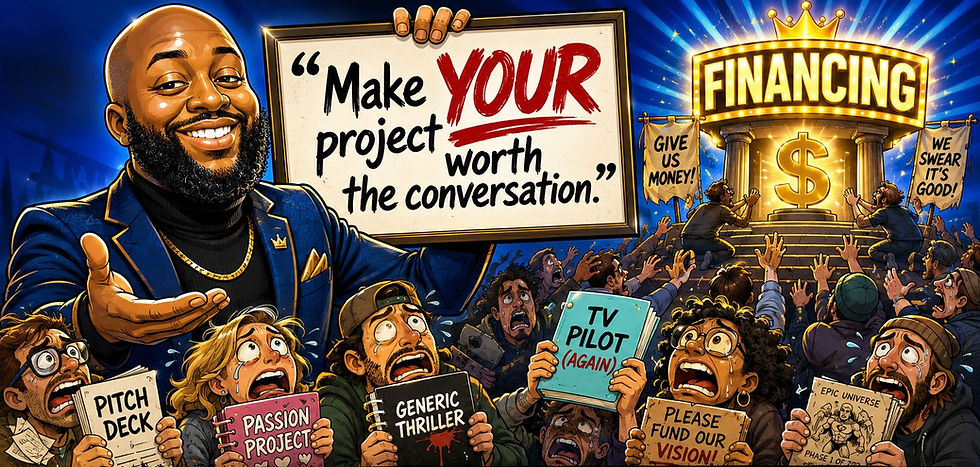
Treat the work as a business before you ask anyone to treat it as art. Business is business. Publish a real finance plan. Show principal cash committed and escrowed. Convert talk into contracts that move revenue. Verify incentives with timelines and lender terms. Align distribution to what buyers are actually doing in 2025, not what they did in 2019. Run your raise under the correct exemption and file what the law requires. Then step into the room.
The current market is not anti-art. It is anti-uncertainty. Projects that align risk, evidence, and compliance still get financed in 2025. Projects that rely on sentiment or social proof do not. That is the difference between the real market and wannabe logic.


Comments